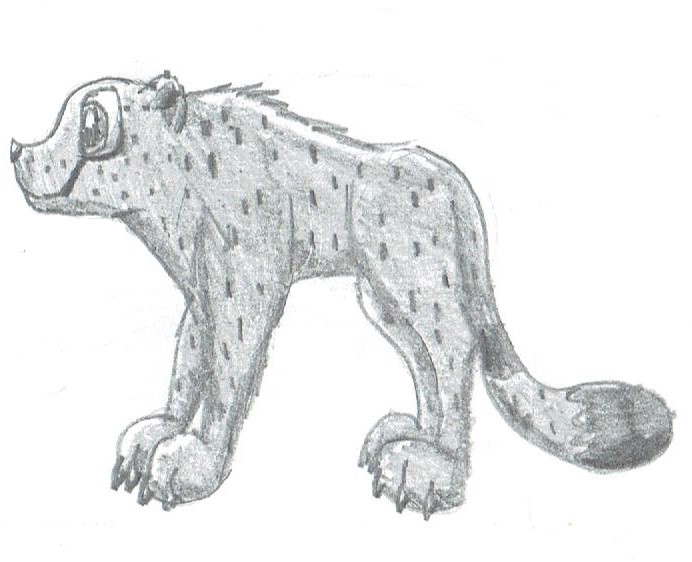
The cheetah is one of the most aesthetically pleasing animals in the world to draw. Known for their incredible speed and sleek, aerodynamic bodies, they represent the peak of evolution in the African Savannah. In this 2009 sketch, I wanted to capture a very specific stage of life: the Teenage Cheetah. There is a unique energy in a young predator. They are eager, full of spirit, and ready to take on the world, yet they still possess a bit of the awkwardness that comes with growth. In this drawing, I aimed to portray that "ready to be grown-up" attitude. This cheetah isn't a cub anymore, but he hasn't yet reached the full, muscular stature of a seasoned hunter.
Simple Bee is the type of sick stuff you can get when that happens. Notice the massive, heavy body that seems to defy the laws of aerodynamics, paired with wings so small they look like an afterthought. Despite these physical limitations, Simple Bee is still driven by a singular, obsessive purpose. It dreams of what all real bees dream of: that sweet sweet golden flower nectar. In its world, there is no other goal. This bee thinks about nectar every second of every day. To it flower is not just food; flower is the entire reason for existence. Without the flower, this bee is nothing-he is just a buzzing void waiting for a purpose. 0-0
Drawing animals at different life stages requires a keen eye for proportion. When I sat down with my #2 pencil and white paper, I had to make several conscious decisions to ensure the character didn't look like a full-grown adult or a tiny baby. 1.Lanky Proportions: Much like human teenagers, young cheetahs go through a "lanky" phase. Their legs often look a bit too long for their bodies, and their paws can seem slightly oversized. I leaned into these "rough" proportions to suggest that he still had some growing to do. 2.The Cheetah's Silhouette: Unlike lions or tigers, which are bulky, cheetahs are built like greyhounds. Capturing the deep chest and the narrow waist is essential. Even in this early 2009 attempt, you can see my focus on the "aerodynamic" curve of the spine. 3.Facial Features: Adult cheetahs have very distinct "tear marks" that run from their eyes to their mouths. On a younger cheetah, I kept the features a bit softer and the eyes slightly larger to maintain that youthful, "eager" expression.
In my original notes, I mentioned that this was a "pretty rough" attempt compared to the work I've done recently. This is a vital part of the artistic process. Many people only want to show their polished, perfect masterpieces, but there is immense value in the rough sketch. A rough sketch is where the "soul" of the drawing lives. Using a standard #2 pencil allows for a certain level of spontaneity. You aren't worried about every single fur detail yet; you are focused on the gesture and the pose. While I can see the imperfections now-the areas where the shading could be smoother or the anatomy more precise-I still love this piece for the raw energy it captures. It was a "first attempt," and first attempts are the foundation of everything that comes after.
Even though at this time I now had artistic pencils, I frequently returned to the #2 pencil during this era because of its accessibility. It is the ultimate "practice" tool. Because it smudges easily and has a limited range of darkness, it forces you to focus on form and line rather than hiding behind complex shading. Drawing a cheetah-with its complex spot patterns-using only a basic pencil is a great exercise in patience. You have to decide which spots to emphasize and how to make them look like they are following the curve of the body rather than just being flat circles on paper.
One of the most rewarding things an artist can do is look back at a piece from over a decade ago. Google AdSense and search engines value "Originality and Transformation." By talking about how this 2009 cheetah compares to my more recent work, I'm providing a narrative of growth that many readers find inspiring. 1.Then (2009): I was focusing on the basic shapes and trying to understand how to move from "cartoon" styles into something more animalistic. 2.Now: I have a better grasp of muscle structure, fur patterns, and light source. 3.The Lesson: You cannot get to the "recent" version without going through the "rough" 2009 version. This teenage cheetah was a necessary stepping stone in my journey to mastering feline anatomy.
The Teenage Cheetah remains a proud part of my "Old" gallery. He represents ambition-both the ambition of the young cat ready to hunt on the savannah and my own ambition as an artist in 2009, eager to move beyond my comfort zone. If you are an artist looking at your own "rough" sketches today, don't be discouraged. That roughness is just proof that you are pushing yourself to learn something new. One day, you'll look back at your "teenage" drawings and realize they were the start of something great.
Date: 2009
Medium:#2 Pencil with white paper