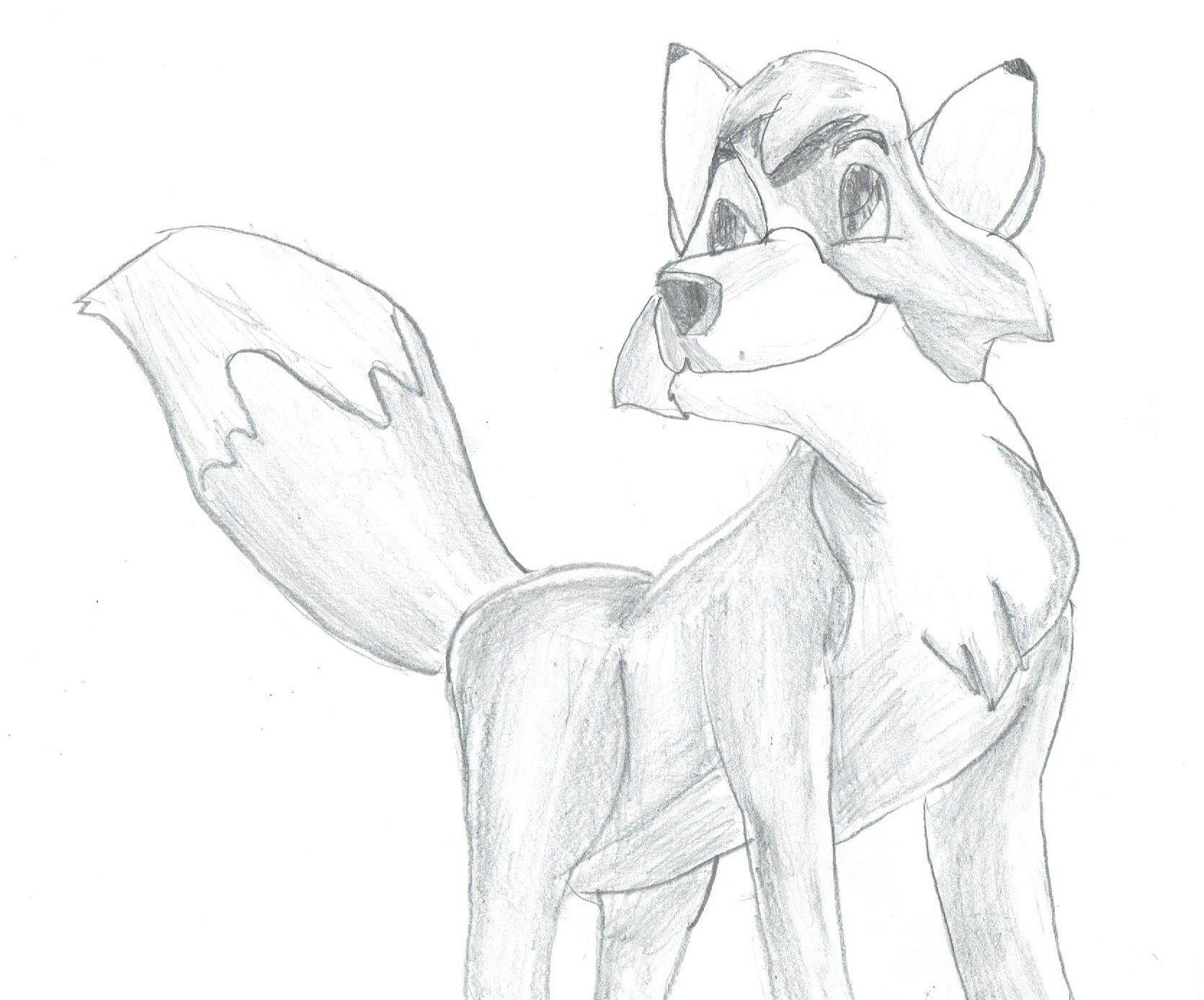
In 2009, I was deeply immersed in the world of animated canines. After finding success with my Balto portrait, I turned my attention to another classic that shaped my childhood: Disney's The Fox and the Hound (1981). The movie tells the bittersweet story of Tod, a fox raised by a kind woman named Widow Tweed, and his unlikely friendship with Copper, a hunting hound.
The film is famous for its emotional depth and its portrayal of the "laws of nature" versus the bonds of friendship. As Tod grows up and is eventually released into the wild to live "bold and free" with his mate, Vixey, his physical design changes from a soft, rounded kit to a sleek, proud adult fox. It was this "proud" version of Tod from the movie case that I chose as my next artistic challenge.
After completing the Balto portrait, I felt a surge of confidence. I had realized that I could draw more realistically than I previously thought, and I assumed that because I could draw a wolf-dog, drawing a fox would be a natural next step. However, as every artist eventually learns, each animal has its own unique "shorthand." 1.Anatomy Differences: While both are canines, a fox has a much more delicate bone structure than a husky or a wolf. Tod has a narrower snout, larger ears relative to his head size, and a much bushier, lighter tail. 2.The "Decent" Result: While the drawing turned out "okay," it didn't quite capture the same "majestic" polish as my Balto piece. In hindsight, I realized that I was better at capturing the heavy, rugged features of Balto than the lithe, cunning features of a red fox. This is a common occurrence in art; sometimes we find a "niche" subject that just clicks with our hand's natural movement. 3.The Power of Reference: Just like the Balto piece, this was a study from a movie case. Using high-quality marketing art as a reference is a fantastic way to understand how professional animators simplify complex anatomy into clean, readable lines.
One of the most important things for an artist to realize is that growth isn't a straight line. You might draw one incredible piece and then follow it up with something that feels like a step backward. I included "Tod" in my gallery specifically to show this reality. Comparing Tod to Balto taught me two things: 1.Species Specialization: Just because you can draw a dog doesn't mean you can automatically draw a fox, a wolf, or a coyote perfectly. Each requires its own study of anatomy and movement. 2.The Importance of Fun: Even though I felt I was "better" at drawing Balto, drawing Tod was still a joy. It allowed me to revisit a movie I loved and spend time with a character who represents freedom and resilience.Tod stands as a reminder of the "experimental" phase of my 2009 art journey. He represents the transition from a beginner to an intermediate artist-a stage where you are brave enough to try new subjects, even if the results aren't always perfect.
For visitors to this gallery, I hope Tod encourages you to keep switching up your subjects. If you always draw what you are "good" at, you'll never discover what you might become "great" at. Tod might not have turned out exactly like the DVD cover, but he helped me understand the subtle differences in canine anatomy that I still use in my work today.
Date: 2009
Medium:white printing paper w #2 pencil